
Mighty Kansas Water
At the University of Kansas, innovation flows freely. Scroll on to see how our scholars and scientists are tackling Kansas’ toughest water issues.
Water is vital to Kansas’ economy and the nation’s agribusiness. In recent decades, the Kansas water supply and quality have come under threat, and KU is leading the way in developing strategies to protect this precious resource.
Where’s most of the water in Kansas? It’s underground.
The University of Kansas is home to the Kansas Geological Survey (KGS), the state’s primary authority for research on geology and groundwater resources. By collecting and analyzing critical geological data, KU researchers at the KGS promote sustainable practices to address the urgent challenge of dwindling water supplies.
Read on to learn how KU researchers are supporting a positive water future locally, nationally, and around the world.
Going below the surface
Beneath the Great Plains, the High Plains aquifer — which includes the formation known as the Ogallala aquifer — stretches across eight states and covers about 30,800 square miles in western and central Kansas.
The High Plains aquifer is vital to the region’s economy, providing drinking water for millions and supporting agricultural industries that generate billions of dollars annually. In Kansas alone, this aquifer supplies up to 80% of the water used daily by Kansans.
In the 1950s and ’60s, advances in technology fueled a surge in large-scale pumping for irrigation in Kansas. Furrow and ditch irrigation came first, followed by center-pivot irrigation systems — massive sprinklers on wheels that traverse fields. This enabled farmers to consistently cultivate crops that the western Kansas climate would not normally support.
By the 1970s, Kansans recognized that overpumping was causing a serious decline in aquifer water levels. In response, Kansas lawmakers enacted legislation to help conserve this resource. Tracking the drop in water levels became a key strategy in addressing the problem. Fortunately, the United States Geological Survey and the Kansas Department of Agriculture’s Division of Water Resources (DWR) had started a groundwater measurement program years before.
In 1996, the KGS at the University of Kansas took over the program and now takes measurements every year, in cooperation with the DWR. The KGS uses about 1,400 wells within the extent of the High Plains aquifer in Kansas to better measure, understand, and manage groundwater supplies.
“Kansas has some of the best water quantity data in the world,” says Jim Butler, a senior scientist at the KGS. “That’s one thing we’re very strong on and very fortunate to have. That data provides the foundation for insights into subsurface conditions that would otherwise remain beyond our reach.”
KU shares data online for public use and collaborates with regional decision-makers to discuss new water practices. “The methods that we’ve developed are beginning to be applied in other states and countries,” says Butler.
Brett Oelke, a fifth-generation farmer from Hoxie, Kansas says “KGS was doing the behind-the-scenes data for us. They kicked back the data telling us that if we cut back our pumping by 20%, we could extend the life of the Ogallala [aquifer] by an additional 20 years.”
One way KU researchers collect data is via irrigation wells that draw water out of the aquifer. Aquifers in Kansas are not underground cave systems. They are subsurface reservoirs with the water stored in porous materials — such as sand and gravel — above an impermeable rock layer.
Irrigation wells use a pipe that stretches from the surface into the water-retaining section of the aquifer. The pumping system draws water up the pipe to be released to the fields. A gauge on these pumps (called a totalizing flow meter) measures the volume of water taken from the aquifer.
“So, the question is, how do we change the narrative?” asks Butler. “That’s where the Kansas Geological Survey plays a role. We can provide data, but we do much more than that. The critical thing is the analysis of that data using new methods that we’ve developed that can help us chart more positive paths forward.”
Educating and informing Kansans about this precious resource is central to the services KU, including the KGS, provides to the public.
KU expertise leads to better policy.
Several times a year, KGS members guide policymakers and public officials into the field to inform them about Kansas water issues and to demonstrate how research supports the state’s decision-makers. These excursions serve as vital opportunities to connect scientific findings with policy options.
During an excursion in May 2025, Jay Kalbas, state geologist of Kansas and director of the KGS, led members of the Kansas Water Office (a state agency responsible for water planning and policy) across parts of central Kansas.
On this excursion, discussion centered on how rock formations store much of the water Kansans use in that region, highlighting the connection between geological history and contemporary water needs.
“At the end of the day, whether you live on the eastern side of Kansas or on the western side of the state,” says Brownie Wilson, KGS’s geohydrology data manager and an educator on the trip, “you’re using water coming from a variety of different sources, and you’re using it for your livelihood.”
These KGS educational excursions directly inform state policy, helping improve water usage practices and extend aquifer life.
KU research doesn’t just drive innovation in sustainable water practices. It also empowers Kansans to take action in safeguarding their water resources and shaping a better future for the state.
Saving time, money, and water
Western Kansas is a dry region that receives around 20 inches of rainfall annually. Despite limited rainfall, farms and ranches in western Kansas thrive, playing a vital role in the nation’s economy and food production.
“We really have some of the most fertile soil in the United States. The only thing we lack is the physical water,” says Brett Oelke, a fifth-generation farmer based near Hoxie, Kansas. “We have some phenomenal dirt.”
Oelke is one of many Kansas farmers who are putting KU data to the test and yielding big results.
With new technologies, farmers are putting KGS data into practice to decrease the amount of water used from the aquifer. This reduces their costs and workload and enhances the quality of life for Kansans.
For example, Oelke is able to monitor his irrigation systems using his phone. He can start and stop sprinklers — just in case it rains — and he receives alerts to any technical issues that may arise, reducing water waste caused by mechanical errors.
“It saves me a ton of time,” says Oelke. “If something breaks on the sprinkler, whether the motor goes bad or there’s a flat tire, the sprinkler will shut off, and I’ll get a message. I’m able to come and directly fix the problem instead of constantly having to micromanage to make sure everything is working.”
KU’s data analysis has inspired farmers to make another adjustment to their farming practices: switching to water-saving nozzles for their irrigation systems.
The “bubbler nozzle” circulates air into the water before it sprays. These nozzles create large droplets of water, very similar to rain. This helps prevent the water from evaporating before it fully soaks into the dirt.
By adjusting their practices, farmers are changing the aquifer’s future.
“Million-dollar decisions are being made from the data we collect and the information we provide. It affects real people, and it’s a real issue in Kansas”, says Brownie Wilson, geohydrology data manager at KGS.
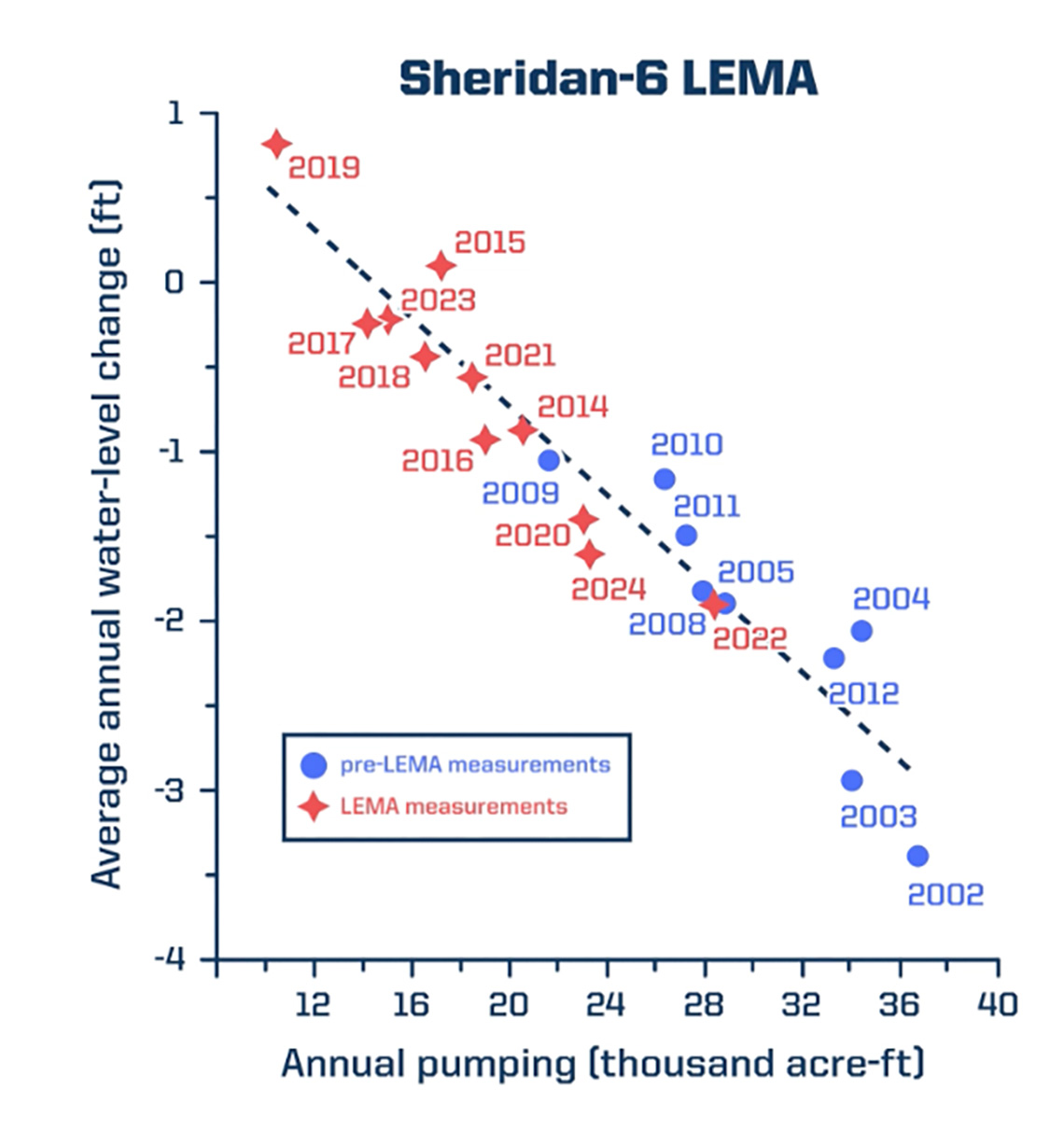
State policies guided by KU analysis are extending the aquifer’s longevity. Oelke and other members of the locally controlled Groundwater Management District 4 (GMD4) are following state-approved Local Enhanced Management Area (LEMA) practices to reduce water use.
State policies guided by KU analysis are extending the aquifer’s longevity. Oelke and other members of the locally controlled Groundwater Management District 4 (GMD4) are following state-approved Local Enhanced Management Area (LEMA) practices to reduce water use.
This chart shows the change in annual water levels before and after GMD4 enacted LEMA practices in six of the counties in GMD4 (known as Sheridan-6). Through reduced pumping, GMD4 was able to lessen the decline rate of aquifer levels by about 62% (adjusting for climatic conditions), creating a more secure future for that portion of the aquifer.
“These are grassroots-driven programs by the irrigators themselves,” says Jim Butler, a senior scientist at the KGS. “We’re just supporting their efforts. We’re all working together to see if we can chart a more positive path forward.”
KU powers an informed and healthy future.
Change is happening on the farm and beyond, and KU is leading the way with innovative technologies and education. To glean more insight into the subsurface, KU researchers are taking to the sky with airborne electromagnetic (AEM) surveying. This technology yields vital data on the geologic structure of the aquifer and helps researchers calculate how Kansas farmers can adjust water usage to extend the lifespan of the aquifer.
AEM surveying involves helicopters lifting large instruments into the air. These instruments transmit electromagnetic signals into the ground and measure the subsurface’s electrical conductivity. Without having to dig or drill, KU researchers can access data that reveals geological structures, groundwater resources, and more.
KU is the only organization in the state performing AEM mapping. So far, KU researchers have used AEM technology to survey 45% of the Ogallala aquifer portion of the High Plains aquifer in western Kansas. This equals 33% of the High Plains aquifer in the state.
“This promising new data will help us fill in the gaps in our characterization of the subsurface and eventually model the three-dimensional architecture of the aquifer itself,” says Jay Kalbas, the state geologist of Kansas and director of the KGS.
At the same time that KU is shaping the water conservation practices of today, KU researchers are also teaching the next generation how to create a more sustainable and healthy future.
Every summer, the Kansas Biological Survey & Center for Ecological Research at KU hosts a three-day program for secondary science teachers. Attendees are empowered and inspired through hands-on learning focused on aquatic ecosystems.
These science teachers carry the value of this program back to their classrooms, informing young Kansans about the state’s diverse ecosystem and what it takes to protect our natural resources.
KU is dedicated to preserving water sources as well as protecting the health of Kansans. Unsafe water can cause a variety of health concerns, including stomach issues and cancer. KU researchers are at the forefront of a new statewide groundwater quality monitoring program called Aquifer Water Quality Assessment for Kansas (AWQUA).
In 2024, the KGS launched AWQUA and began sampling well-water quality across the state. In summer 2025, they started outreach programs to share information with rural Kansans on the importance of evaluating groundwater quality. By partnering with K-12 teachers, KU is connecting communities with the solutions they need to improve their quality of life.
“This KGS outreach program provides an educational experience and a connection between KU and teachers throughout the state,” says Anthony Cole, a science teacher for grades 8-12 in Stockton, a town in western Kansas. “Many in the public arena take clean water for granted. These programs offer insight into new approaches on how to teach topics, and I can promote the importance of clean water.”
AWQUA will soon be expanding their data collection and analysis by working with researchers at the Kansas Center for Rural Health, a division of the University of Kansas Medical Center that explores ways to reduce and eliminate health disparities in rural Kansas.
“[The U.S.] simply does not regulate domestic well water at the federal level, we don’t do it at the state level, and we don’t even have good national data,” says Tom Mueller, director of the Kansas Center for Rural Health. “This will be an exciting and new collaboration.”
As part of the partnership program, KU will create a public data platform that combines groundwater-quality findings across agencies and links with existing KGS water databases.
“We want to provide rural Kansans with access to information on their groundwater quality, as much as [people] on public water supplies have,” says Scott Ishman, a senior scientist at the KGS.
Once the data is compiled, this platform will provide Kansans with information they can use to make informed decisions to protect themselves from health issues due to unsafe groundwater.
Any water protected today is water that can be used in the future. To that end, KU researchers are proactive and collaborative, working with communities to create positive change. Through education and analysis, KU empowers farmers, advises policymakers, and teaches the next generation that we can all do better by working together.
There’s always more work to be done around water sustainability. KU will be there to lead the way toward a world that is safer, healthier, and stronger for everyone.
KU's water research flows in all directions.
Innovators at KU take on the water issues of today to create an informed tomorrow.